


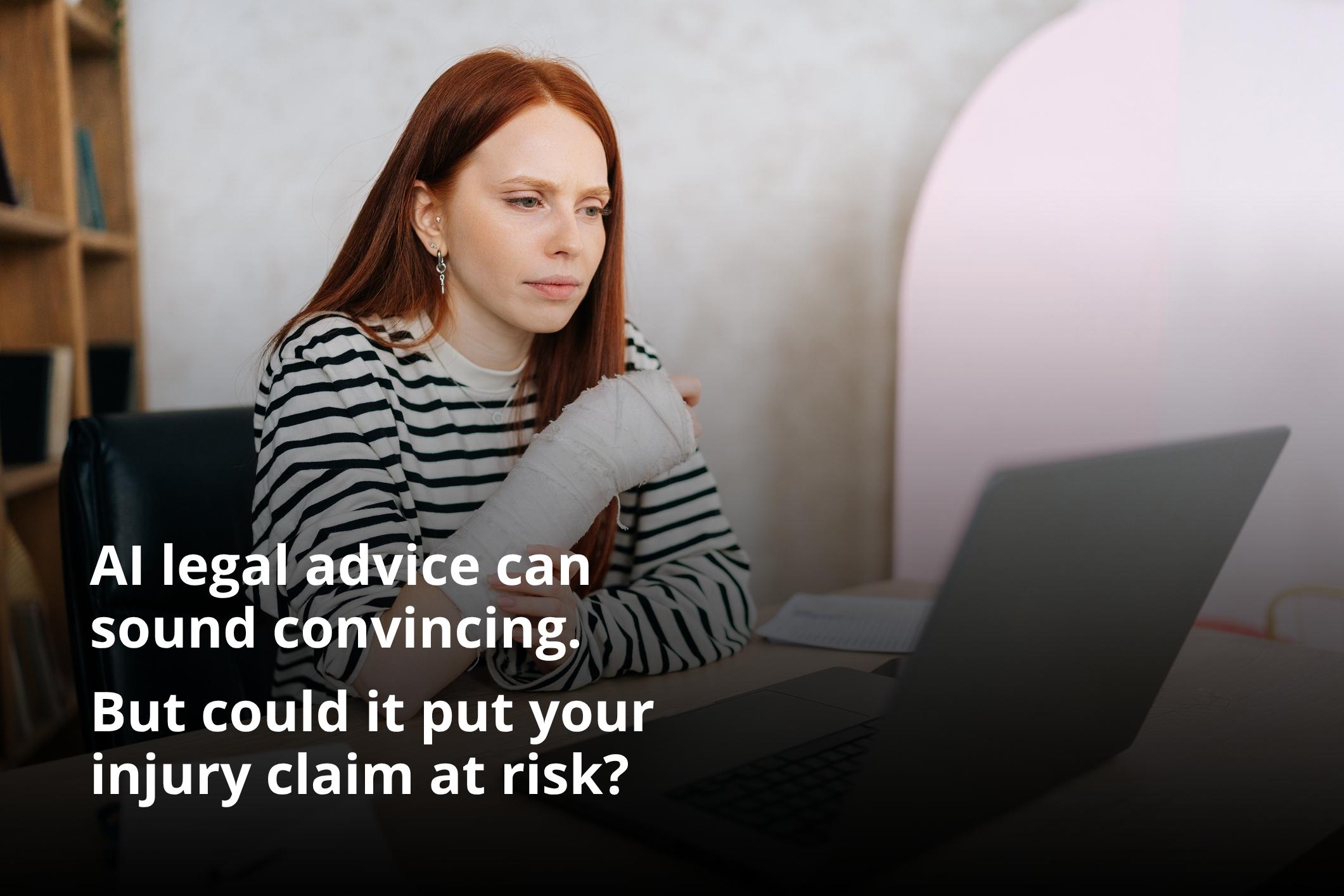
You've told ChatGPT about your accident, explained your injuries, and asked whether you have a case. A few seconds later, you're reading a detailed answer about California law, who's responsible, and how much money you might receive.
It sounds convincing. There are legal terms, references to court decisions, and explanations that seem to fit what happened to you. You might even feel like you've gotten a head start on figuring out your next move.
You're not alone. According to the American Bar Association, 13% of surveyed legal consumers have used AI tools to research legal issues. When you're dealing with medical bills, insurance calls, and time away from work, getting answers without waiting for an appointment has obvious appeal.
But there's something you need to know before telling ChatGPT anything else about your accident: Your conversations with AI aren't protected by attorney-client privilege. And the information you're sharing could create problems for your case, even if the legal advice you receive sounds perfectly reasonable.
At Thorsnes Bartolotta McGuire, we recommend against discussing the details of your accident, injuries, insurance negotiations, or potential lawsuit with ChatGPT or other public AI tools.
Already asked ChatGPT about your accident? Before relying on its advice or sharing additional details, speak with an attorney. Call (619) 236-9363 or contact Thorsnes Bartolotta McGuire online for a free consultation.
ChatGPT has a way of making complicated subjects sound straightforward. You ask a question, and it gives you an organized explanation, often with specific laws or cases to back it up.
The problem is that those references aren't always accurate.
Researchers at Stanford Law School tested AI legal research tools developed by major legal information companies. Even those specialized systems gave inaccurate or fabricated information more than 17% of the time.
For someone researching an injury claim, that could mean getting the wrong deadline for filing a lawsuit, reading about a California law that doesn't apply to their accident, or receiving a settlement estimate based on information that hasn't been verified.
A citation doesn't guarantee an answer is correct, either. ChatGPT can reference a real court decision and still misunderstand what the court said. It can also provide a case name that looks legitimate but doesn't exist.
You probably aren't going to spend your recovery reading court opinions to check every answer. That's understandable. But trying to get a more accurate response by supplying additional medical records, insurance documents, or private details about your accident introduces another risk.
And again, the more information you share with AI about your case, the more sensitive information you're placing outside the confidential attorney-client relationship.
When you speak privately with an attorney for legal advice, those communications are generally protected by attorney-client privilege. The law recognizes that people need to discuss sensitive information openly with their lawyers to receive appropriate legal representation.
That protection generally doesn't extend to conversations you have independently with ChatGPT or another AI chatbot.
Suppose you've been negotiating with an insurance company. You're frustrated with its settlement offer, so you upload the letter to ChatGPT and ask whether you should accept it. You also explain what your attorney told you about the offer and what you're willing to settle for.
You've now shared information about your legal strategy, negotiations, and potentially privileged attorney communications with a third-party service.
Depending on the circumstances, disclosing privileged information to a third party could jeopardize its protection. Certain AI conversations or documents created through those services could also become the subject of discovery requests during litigation, although whether they must be produced would depend on the applicable law and circumstances.
AI platforms have their own data retention, privacy, and account settings. Those settings don't establish an attorney-client relationship or provide the legal protections that come with one.
Our recommendation is to keep the details of your case out of public AI tools, including:
- Conversations, emails, or messages with your attorney;
- Legal advice, case evaluations, or discussions about strategy;
- Settlement offers, demands, and negotiation details;
- Medical records and sensitive information about your injuries;
- Accident reports, witness statements, photographs, and other case evidence; and
- Private information about witnesses, family members, or other people involved.
Even information that seems harmless on its own could reveal something about your case when combined with other details.
You don't need to upload your records or explain exactly what happened to learn what comparative negligence means or how a personal injury lawsuit generally works in California.
Say you were riding in a van when the driver lost control and the vehicle rolled over. You suffered a serious spinal cord injury, and now you're trying to figure out whether you can sue the driver.
You ask ChatGPT, and it explains negligence, insurance coverage, and compensation for your injuries. Based on what you've told it, the answer makes sense.
But what about the van?
Was the seat belt working properly? Did the roof collapse more than it should have? Could a problem with the vehicle's design have made your injuries worse?
Those are questions most passengers wouldn't know to ask.
Thorsnes Bartolotta McGuire has handled a case involving those very issues. After a Ford van rolled over, leaving our client quadriplegic, the investigation uncovered problems with the vehicle's seat restraint system and roof protection. The case ultimately resulted in a $20.3 million jury verdict.
The client didn't need to know how vehicle safety systems were engineered to recognize that something had gone terribly wrong. Figuring out exactly what happened required examining the vehicle and understanding how its safety features performed during the crash.
A serious injury investigation can uncover information you wouldn't necessarily have access to, including maintenance records, surveillance footage, product defects, or evidence involving other people or companies.
And there's another reason to avoid asking AI to evaluate your specific accident: It can only work with the information you provide and any other information it can access. You could share extensive details about your injuries and still receive an assessment that overlooks an entirely different source of liability.
You ask ChatGPT whether you have a case. It tells you that because you were partly responsible for the accident, you probably won't recover much compensation. You decide it isn't worth pursuing.
But California law allows injured people to recover compensation even when they share some responsibility for an accident.
Under the state's pure comparative negligence rule, your compensation is generally reduced by your percentage of fault. If your damages total $200,000 and you're found 25% responsible, you could still recover $150,000.
Of course, that raises another question: Who decided you were 25% responsible?
An insurance company might say you contributed to the accident, but that doesn't mean its assessment is correct. The available evidence can tell a different story, and the percentage of fault can become a major point of disagreement.
Other situations where an incorrect AI answer could affect your claim include:
- Missing a deadline. California generally gives you two years to file a personal injury lawsuit, but certain cases have shorter deadlines and additional requirements.
- Accepting an insurance settlement too soon. Once you sign a release, you generally can't go back and ask for more money if your injuries turn out to be worse than expected.
- Underestimating your injuries. Some conditions take time to diagnose, and the long-term effects may not be clear during the first few weeks.
- Overlooking someone who shares responsibility. Another driver, a manufacturer, a property owner, or another party could have contributed to what happened.
You could end up accepting far less money than your injuries warrant, missing your chance to file a lawsuit, or giving up on a claim you had every right to pursue.
And asking ChatGPT to reconsider its answer by uploading more documents or sharing additional details isn't the solution. That approach introduces privacy and confidentiality concerns without guaranteeing a more accurate legal assessment.
Before you share a settlement offer with AI or rely on its opinion of what your case is worth, speak with an attorney. Call Thorsnes Bartolotta McGuire at (619) 236-9363 to discuss your options.
After an accident, you may have information scattered across text messages, medical records, emails, and notes. Asking ChatGPT to organize everything into a summary for a law firm can seem like a convenient way to save time.
We recommend against uploading those materials to an AI chatbot. Your medical records, insurance correspondence, witness information, and conversations with your attorney could contain private or privileged information that shouldn't be shared with a third-party service.
There's also the question of accuracy.
For example, you might tell ChatGPT that you aren't sure whether the other driver stopped at a red light. When it rewrites your account, it might state that the driver ran the light. That's a big difference, and it could create confusion later if you submit the summary without catching the change.
AI-generated summaries can also leave out injuries, alter dates, or introduce assumptions about who caused the accident. A polished account isn't necessarily an accurate one.
You don't have to sound like a lawyer when you contact one. Explain what you remember, share what you're unsure about, and provide whatever records you have through the firm's recommended communication channels.
If you've already used ChatGPT to prepare an accident summary, let your attorney know. Keep your original notes and documents so your legal team can distinguish what you actually observed from anything the AI tool added or changed.
Maybe you've already uploaded an insurance letter, described your injuries, or asked ChatGPT to evaluate a settlement offer. There's no reason to panic, but you should stop sharing additional case information until you've spoken with your attorney.
Tell your lawyer what information you entered, whether you uploaded documents, and whether any of those materials contained communications with your legal team. Your attorney can assess whether the disclosure raises confidentiality, privilege, or evidence-related concerns.
Don't delete or alter potentially relevant conversations or documents without legal advice, especially if litigation is pending or anticipated. Your attorney can advise you about preserving records and addressing any information you've already shared.
You can still use AI to learn general legal terminology or develop questions to ask during a consultation. But when it comes to the facts of your accident, your injuries, your communications with counsel, and decisions about your claim, our advice is to keep those conversations between you and your attorney.
Talk to Thorsnes Bartolotta McGuire Before Sharing Your Case With AI
It's understandable to want answers about your accident before calling a law firm. AI makes legal information easy to access, and some of its explanations can be useful for understanding unfamiliar terms.
But your personal injury claim involves private information, legal rights, and decisions that could affect your financial future. An AI chatbot doesn't provide attorney-client privilege, and an answer that sounds convincing could still be wrong.
Since 1978, Thorsnes Bartolotta McGuire has represented injured Californians and recovered more than $2 billion in verdicts and settlements. We've handled serious personal injury cases involving defective vehicles, catastrophic injuries, and accidents where the full extent of the harm wasn't immediately apparent.
Before you upload another document, describe your legal strategy, or rely on an AI-generated assessment of your claim, talk to us. Call (619) 236-9363 or contact Thorsnes Bartolotta McGuire to schedule a free consultation.