
.avif)

The government has the power to take private property for public use. When it does, the law requires fair compensation. The problem is that government agencies do not always pay, and sometimes they damage or destroy property without ever acknowledging their actions.
.avif)
That is where inverse condemnation becomes relevant to property owners. When a government agency takes, damages, or destroys your property without going through the formal condemnation process, you have the right to pursue compensation.
Below, we explain what is inverse condemnation, how it affects property owners, and what you may be able to recover.
Thorsnes Bartolotta McGuire has represented property owners against government agencies for over four decades. Call (619) 236-9363 to speak with an inverse condemnation attorney today.
The inverse condemnation meaning comes from a basic constitutional principle: the government must pay for private property it takes or damages for public use. When it fails to do so, the property owner can bring a legal claim to recover compensation.
Instead of the government starting the process, the property owner initiates the case. You are asking the court to recognize that a taking or damage already occurred and to require payment for it.
These claims can arise from a variety of government actions, including:
- Physical damage caused by public projects, such as flooding or landslides;
- Regulations that severely limit how property can be used or accessed; or
- Infrastructure failures, including utility-related wildfires.
The key difference from eminent domain lies in who acts first and who carries the burden. In eminent domain, the government files the action, gives notice, and seeks to acquire the property while paying compensation upfront.
In inverse condemnation law, the government has already acted—or failed to act—and the property owner must step in. You bring the claim and present the evidence that your property was taken or damaged without just compensation.
Because proving these claims can be difficult, many property owners benefit from having an experienced inverse condemnation attorney.
Infrastructure Failure
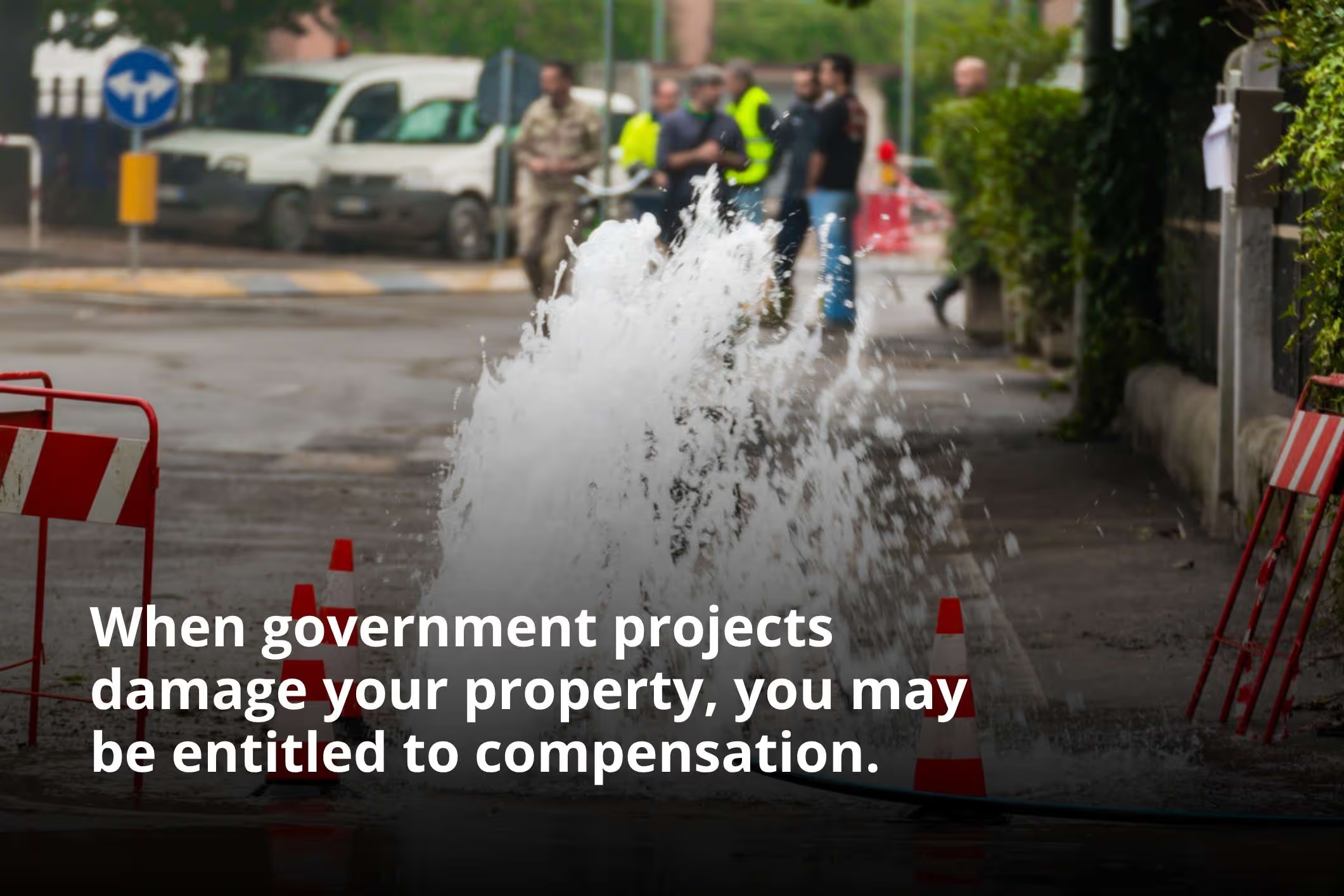
An aging water main beneath your street bursts one night. Thousands of gallons of water flood your property, cracking the foundation, eroding your yard, and damaging the structure your family has owned for decades. The pipe was publicly owned and maintained.
Flood Control Damage
The county builds a new levee system upstream to protect a commercial district from seasonal flooding. The project redirects water flow onto your land. Over the following rainy season, your property floods repeatedly. Crops are destroyed, fencing is lost, and soil that took years to cultivate washes away.
Utility-Related Damage
Power lines running through the hills near your property are owned and maintained by a public utility. During a windstorm, equipment on those lines throws a spark that ignites a fire. The fire moves quickly. By the time it is contained, your home is gone. The equipment was theirs, and the maintenance was their responsibility.
Construction Impacts
A freeway expansion project begins near your commercial property. The excavation required to widen the roadway destabilizes the hillside adjacent to your building. Weeks into construction, a landslide damages your structure and makes portions of your property unusable.
If one of those scenarios sounds familiar, your situation may qualify as inverse condemnation. Thorsnes Bartolotta McGuire has recovered over $2 billion for property owners in disputes with government entities. Call (619) 236-9363 to speak with an attorney about what happened to your property.
No. Inverse condemnation is a strict liability claim. This means you do not have to prove the government was careless or at fault in causing the damage. The key issue is whether your property was damaged or taken for public use, not whether the government intended the harm or acted negligently.
So, to support an inverse condemnation claim, you need to establish four things:
- Ownership: You hold an actionable interest in the property.
- Government Action: A government entity substantially participated in a public project, such as planning, construction, or maintenance.
- Taking or Damage: Your property suffered physical damage or a significant loss in value.
- Causation: The public project was a substantial cause of that damage.
A note for California property owners: You must show the damage was an inherent risk tied to the public project's design or maintenance, not simply an accident unrelated to its public purpose.
For example, if a city’s storm drainage system is designed in a way that predictably causes flooding on nearby properties during heavy rain, that flooding may support an inverse condemnation claim.
By contrast, a one-time water main break caused by an isolated construction mistake may not qualify, because it is not inherent to the project’s design or intended function.
Property owners in inverse condemnation cases are entitled to just compensation for the costs they incur from the government's actions. Depending on the circumstances, that can include:
- Fair market value for property taken outright, based on what a willing buyer would pay;
- Diminution in value for the loss in property value caused by flooding, restricted access, noise, or other impacts from public projects;
- Repair costs for physical damage caused by public infrastructure, such as burst pipes, utility-caused fires, or sewer failures;
- Loss of use and income for rental income, business profits, or the reasonable rental value of property that became inaccessible or unusable; and
- Relocation expenses for costs incurred moving when damage made the property uninhabitable or unusable.
Not Sure If You Have a Case? Call an Inverse Condemnation Attorney Today
Thorsnes Bartolotta McGuire has represented property owners against government agencies since 1978, recovering more than $2 billion in verdicts and settlements. Our firm has handled some of the most complex property damage cases in California, including a $136 million award in a condemnation case against the City of San Diego.
If your property was damaged by a public project and no compensation was paid, call (619) 236-9363 or contact us online to speak with an inverse condemnation attorney.